
Law Nerd: former Deputy DA, Emily D. Baker livestreams pop-culture trials to a global audience
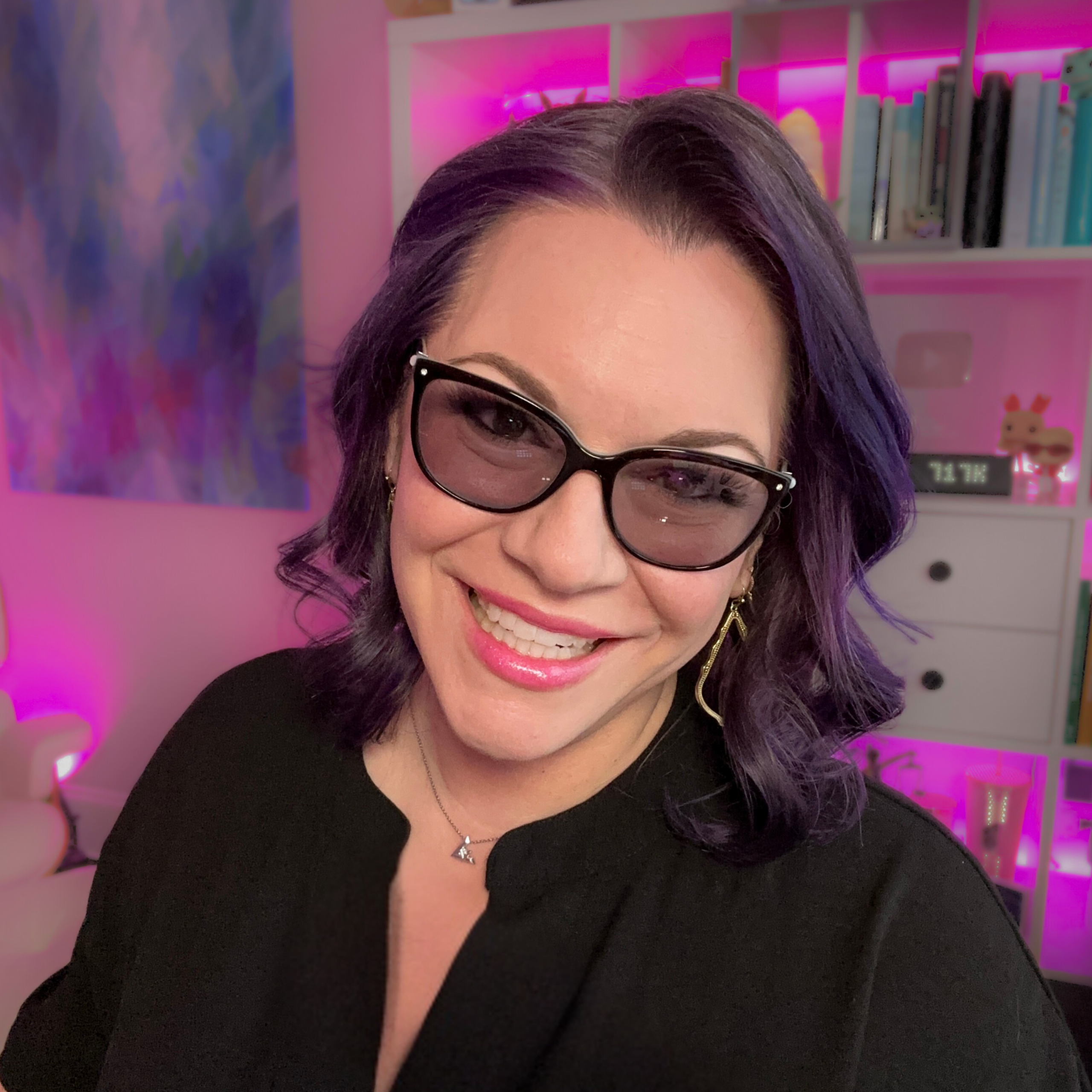
by Laura Garber
Emily D. Baker has a sense of humor that’s often unsuitable for the courtroom.
“Miss Baker, I’m the only one who’s allowed to be funny in this courtroom,” Baker recalled a judge telling her during jury selection for a murder trial. “If you do it again, I am going to make you grab your checkbook,” the judge said. Baker and the rest of the jurors chuckled, thinking he was breaking the tension building in the room.
“No, I’m serious,” he said.
But Baker’s humor, sprinkled with bouts of delicious profanity, found a home perfectly suited for the online legal community she’s cultivated through her YouTube channel, Emily D. Baker.
Baker was a Los Angeles Deputy District Attorney for 15 years. Now, the podcaster and livestreamer breaks down the complicated legal jargon of high-profile trials for a global audience.
Her live trial coverage, including the Johnny Depp vs. Amber Heard defamation lawsuit, and Britney Spear’s conservatorship case, have garnered over 215 million views on YouTube.
“We are focused on facts not f***ery,” Baker said, “If there is f***ery, then we call it such and talk about it. But we don’t try to make the f***ery into the facts.”
Baker ensures she is clear between what is presented in court, her opinion, what is known and what questions remain while “embracing the ability to question our legal system because people don’t feel that they can,” she said.
One of her 850,000 YouTube followers identified her appeal by commenting, “We are now going to lawyers on YouTube for our news. It is the only way to get the breakdown and real facts. There was a vacuum and you filled it with excellence. Our culture is now changed b/c of you and others.”
Her app, “Law Nerd,” on Google Play, has over 10,000 downloads. Her community, dubbed the same name, stays connected through the app and by commenting on her YouTube livestreams for a small fee.
In the Gwyneth Paltrow ski collision trial in 2023, plaintiff Terry Sanderson sued Paltrow for $3.1 million over a 2016 ski accident where he alleged Paltrow recklessly skied into him. Paltrow contended that Sanderson was responsible for the collision. Baker was covering the trial with her audience when the neurologist testifying on behalf of Sanderson spoke about how the collision changed Sanderson’s visual memory. “It sparked a fascinating conversation with the 30,000 to 50,000 odd people who were in the chat discussing the different types of visualization and memory.” Baker said.
From the discussion, she learned she has aphantasia, meaning she doesn’t visualize images. “It’s always interesting to keep learning with the experts even though I’m not the one in the courtroom doing the cases. It’s kind of half being engaged with trial work, but also not being the one doing the trial.”
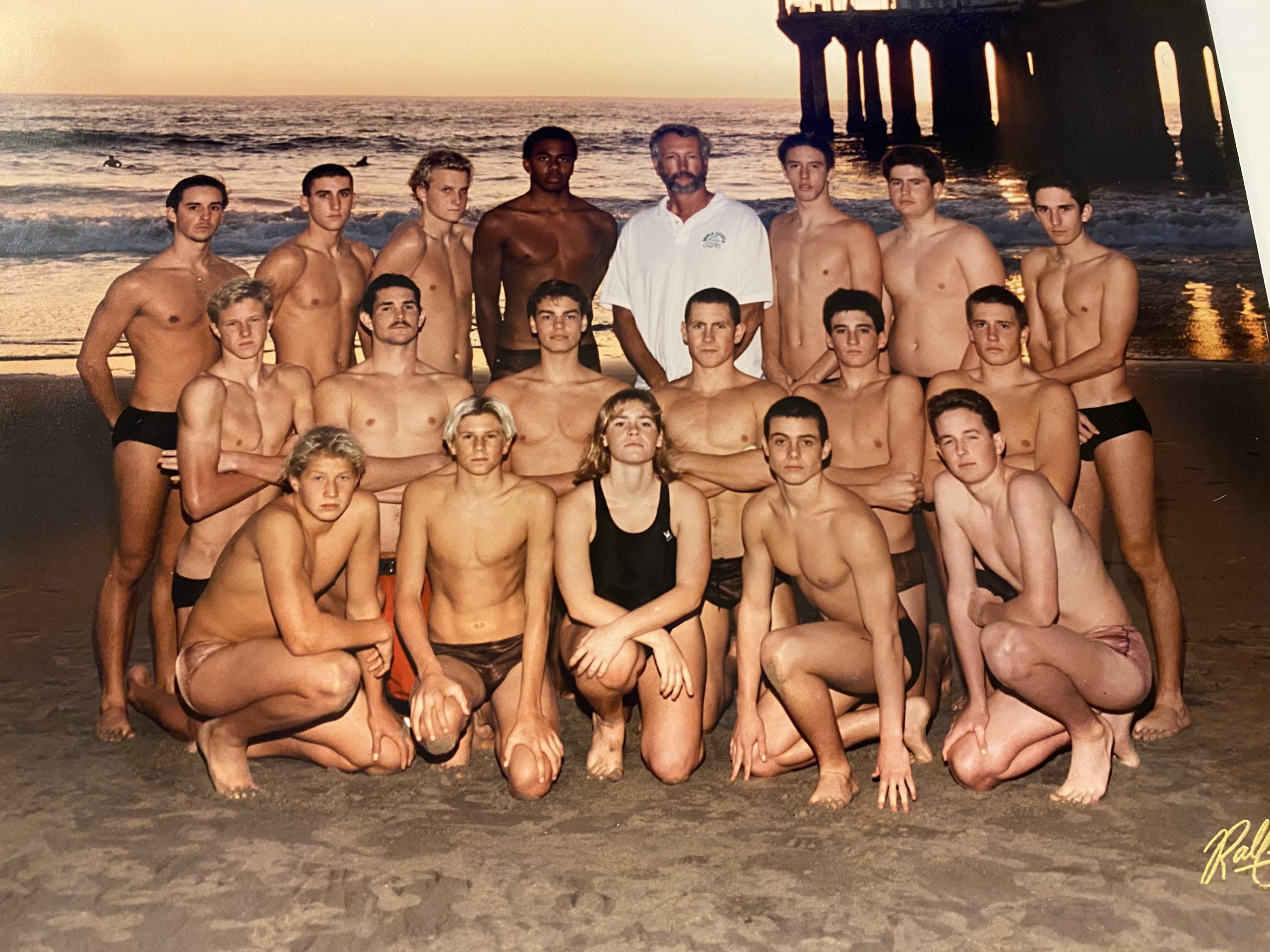
Emily Baker played for the water polo team at Mira Costa as the only female player all four years. Photos Courtesy of Emily Baker.
Baker traces part of her success back to being the sole female on the Mira Costa water polo team during all four years in the mid-’90s, at a time when the school did not have a female water polo team.
“I showed up for the first day of water polo practice and said, I want to play water polo,” Baker recalled. When the coach informed her that this was the men’s team practice, Baker asked where the women’s team was. The coach told her there wasn’t one. “And I said, well, then, this is the water polo team.”
After being the only female player for all four years on the men’s team, she was determined to play collegiately.
However, a shoulder injury sustained while playing D1 water polo for the University of Massachusetts led to a difficult recovery period, prompting her to reflect on her future.
She decided to practice law. After earning her degree at Southwestern Law School in Los Angeles she joined the Los Angeles Deputy District Attorney’s office. She worked there from 2004 to 2020
“A lot of trial attorneys are former athletes. There is a competitiveness, but there’s also a ‘stick through the parts that suck’ that athletes are familiar with,” Baker noted. “The judge is going to make rulings. You might not like them, but you have to keep going. So it is not too dissimilar [from water polo]. Unless you punch someone in court, for which you’re definitely going to get into trouble.”
The demanding trial schedules of a deputy district attorney didn’t leave time for Baker’s family schedule, which included school drop-offs and national marching band tournaments. When COVID slowed down the courts, Baker moved to Nashville, Tennessee and used her law background to help clients apply for payroll protection, small business administration loans and other government funded pandemic programs.
She livestreamed her consultations so people could ask questions in real time. That led to discussing pop-culture cases during her livestreams. “The case where I saw the most conversation at the time was the Britney Spears Conservatorship,” Baker said.
While the internet focused on spurious issues such as whether Spears’ yellow sweater in a dancing Instagram post was a secret “easter egg,” signaling pertinent clues, Baker dove into the legal documents.
“What is going on? Why are there no financial accountings? Where is this money going,” she asked. “There was more here than I anticipated. I would have been reading this on my own time, even if I wasn’t covering it online,” she said.
Baker reveals what is going on behind the high-profile trial headlines, often using profanity and dark humor.
“The law definitely makes you want to curse,” she said.
“I try to make sure the levity is directed at the system, and not at the participants, who often have no choice but to be there. Every now and then the lawyers will say something that is either ridiculous, or delicious, or sassy or all of the above.”
Baker’s legal commentary can surpass the three hour mark for high profile cases, such as the Karen Read trial, which saw a dramatic spike in viewership. Read was found not guilty of murdering her Boston Police Officer boyfriend. And the trial of Bryan Kohberger, who was found guilty of murdering multiple Idaho University coeds.
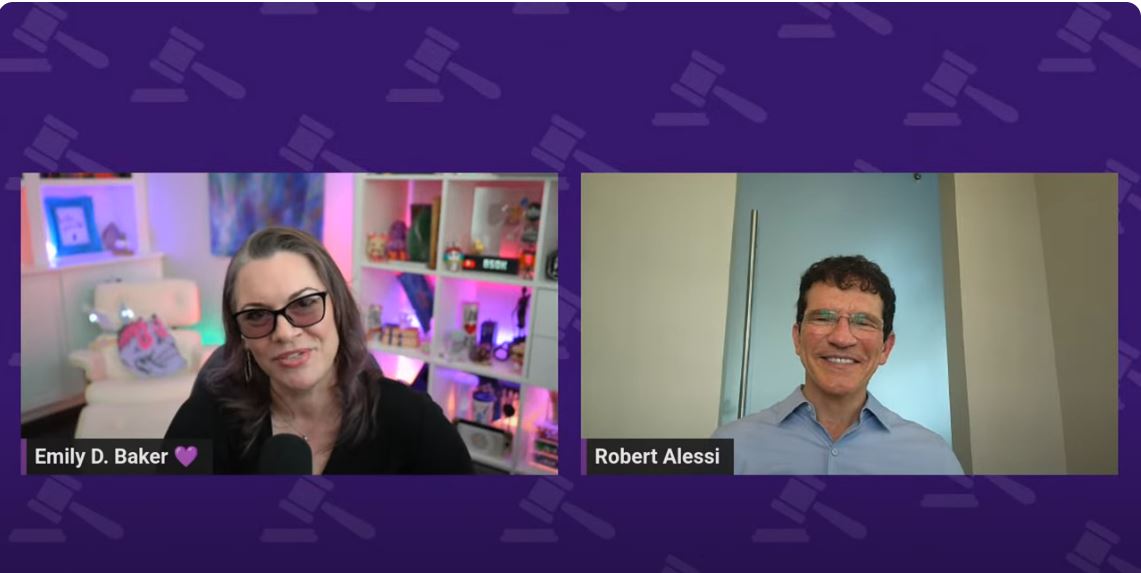
Emily Baker interviews Karen Read’s defense attorney, Robert Alessi, during her livestream. The video has over 200,000 views.
Robert Alessi, a defense lawyer in the Read case, livestreamed with Baker at the conclusion of his client’s trial.
“To translate for viewers what they’re watching exponentially increases their understanding of the trial,” Alessi told Baker. “You bring an absolutely delightful humor and humanity to the law, and sometimes you’re completely unpredictable, which I find absolutely fetching. I hope you continue, because it is almost as important as what goes on in the courtroom. If people don’t understand what’s going on in the courtroom, it isn’t going to get people where I hope they can get.”
Baker told Alessi during the interview, “I spent a lot of my career in complex litigation. White collar and computer crimes is where I found my sweet spot in a DA’s office full of people who wanted to do blood and guts, gang homicides and the rest. I was like bring me boxes of paper and bank accounts and I will be the happiest girl in the world. I could translate what looked like complex cases into a few basic principles of greed, theft or passion.”
The juicy bits audiences will often miss out on, if not for Baker, are baked into court filings not presented during trials. She reads the documents as they scroll beside her during livestreams, distilling their meaning and allowing questions and observations from her fanbase.
Finding the humor is what Baker does best. She’ll define “preservation orders” as “don’t delete your shit.” Or the “Ipse dixit” often used by attorneys in the Karen Read trials, as “because I said so.”
Baker’s main demographic is women in their mid-forties, the people who grew up with the sensationalized O.J. Simpson trial in Los Angeles.
“We get a lot of really genuine questions, and it’s not just people in the US, but people all over the world because our legal system and our pop-culture have so much impact internationally,” she said.
American audiences may take for granted the oddities of the jury duty process. “People ask, ‘Wait. They get a thing in the mail, and then they don’t go to work and they have to go decide if someone committed a murder.’” Baker said. “It’s an interesting system to explain.”
“Everything in the law has a reason. It might not always be something people agree with, but if you can find the reason, you can generally figure out why the results are what they are,” Baker said.
Baker attributed the success of her show to its stars.
“Lawyers are dramatic. Lawyers are theatrical. Lawyers really do argue their case in a way. I often quote ‘Chicago,’ ‘Give ’em the old razzle dazzle,’” Baker said, referring to the jazzy, celebrity-criminal themed Broadway musical song.
When Baker isn’t livestreaming, she’s sifting through hundreds of court documents and curating her brand’s merchandise. This includes “law nerd” themed apparel including T-shirts, hats, and stickers, as well as products such as “Neuro Spicy” lapel pins. The pins, an homage to neurodiversity, are inspired by inside jokes from her online community.
Baker’s current schedule is dictated by the case of Donna Adelson, a Florida mother-in-law convicted of the first-degree murder of her son-in-law, Dan Markel, because of a custody battle between Markel and his ex-wife, Wendi Adelson.
Live court coverage tends to showcase criminal proceedings, but Baker’s interests also include defamation cases in the online space and platform (social media) cases that include big tech players such as Google, X and YouTube. Baker will follow the upcoming case of the Federal Trade Commission suing Ticketmaster over allegedly deceptive ticket resales.
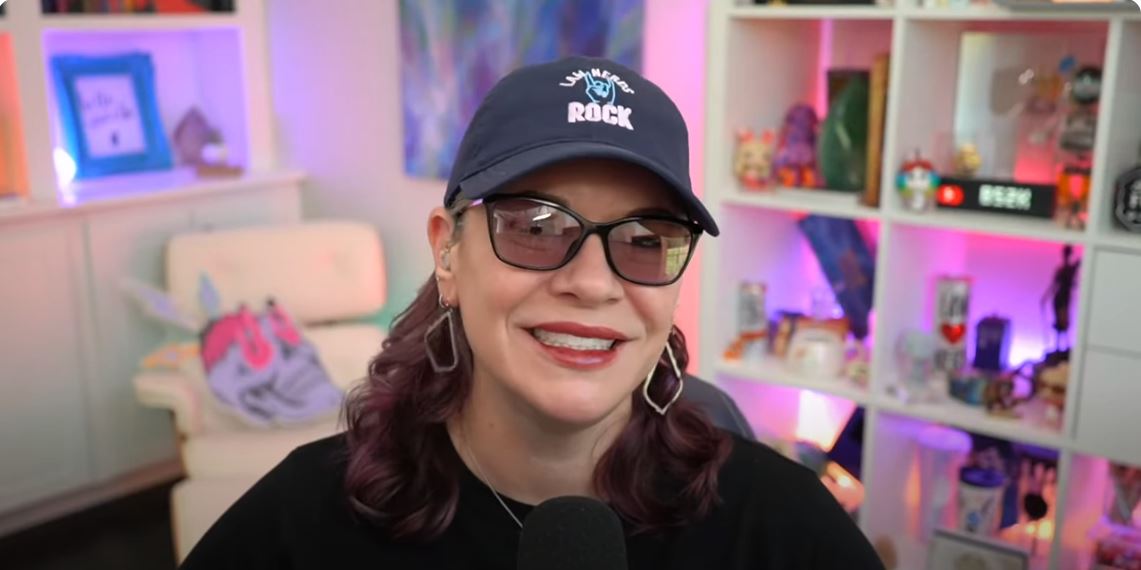
Manhattan Beach native Emily D. Baker, wearing a ‘Law Nerds Rock’ hat during a livestream covering the nationalized Karen Read case. Photo still from Emily D. Baker YouTube Channel.
Better than scripted TV, Baker leaves audiences with questions that equate to desirable cliffhangers. “Will he testify in trial? Will there be a mistrial?”
Baker reminds her audience trials can drag out for weeks, months and even years. “You’re not binge watching it on Netflix to get to the end of the series, and that’s something that is kind of nostalgic for a lot of us,” she said. “Waiting for a verdict is common for trial attorneys, but unique for a viewing audience.”
She misses the South Bay, she said, but prefers the Nashville countryside, with its two gigabit internet connection (important for livestreams) and a quiet stillness, something she didn’t have in the South Bay.
“I miss the people I adore. I miss Beckers Bakery cookies and sandwiches. But I really do not miss the faster pace, the traffic and the parking,” Baker said. ER