
Behind the camera with Garry Winogrand
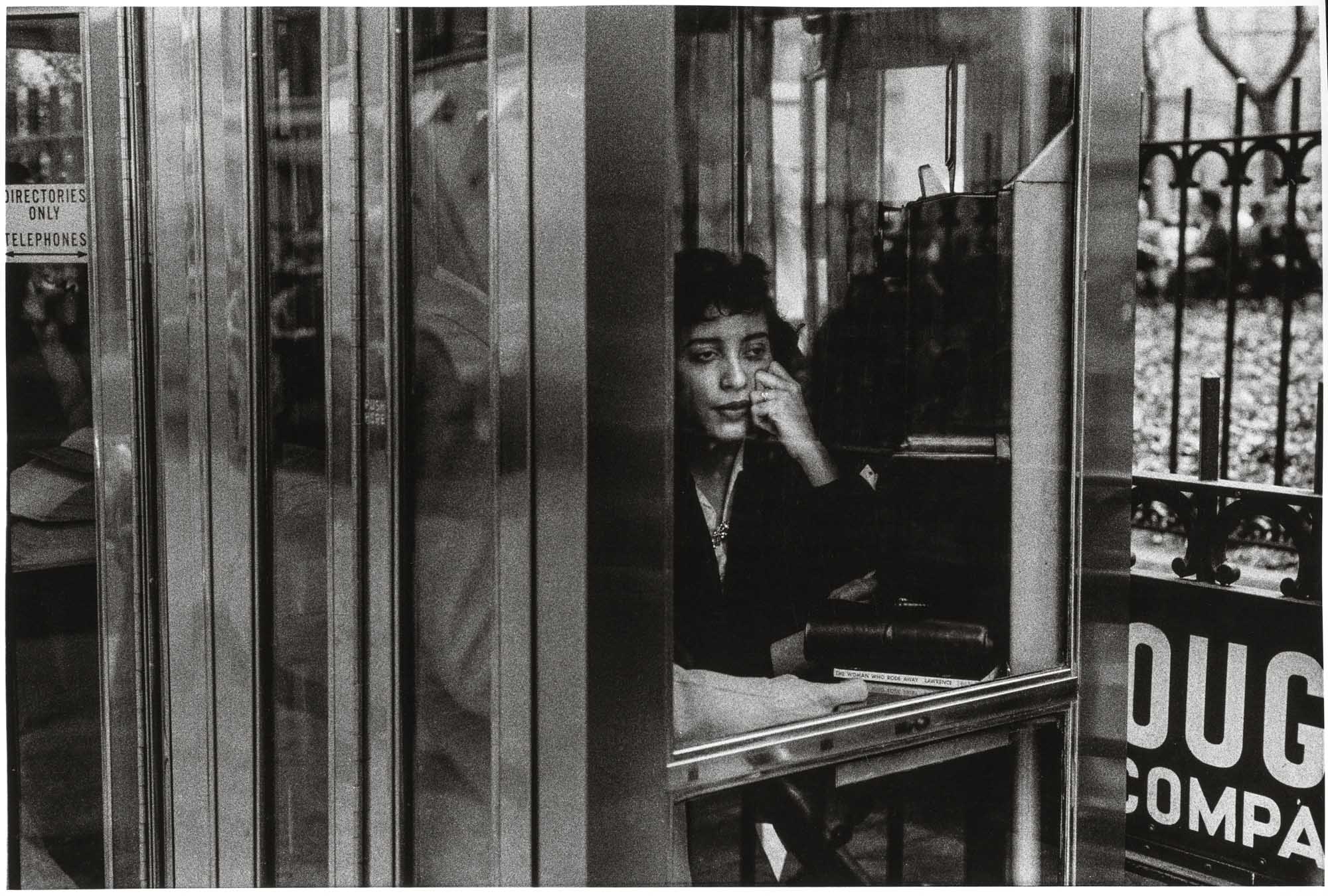

1950s, New York. Photo by Garry Winogrand, courtesy of the Garry Winogrand Archive, Center for Creative Photography, University of Arizona
“The Street Photography of Garry Winogrand,” by Geoff Dyer (University of Texas Press, 239 pp., $60)
There are many scholarly, objective books about photographer Garry Winogrand (1928-1984), but this isn’t one of them. Here, we’ll let the author, Geoff Dyer, explain: “Within the limits of authorial responsibility I have never seen the point in writing stuff that people can easily find elsewhere.”
As the title implies, these images are open narratives, a glimpse or slice of the world caught in mid-stride or, if you prefer, like a fly in amber. Winogrand was well known for being out in public and–click, click, click–peeling off hundreds and thousands of shots.

“Garry Winogrand, Midtown Manhattan Calling His Answering Service, 1967” by Jonathan Brand. Portland Art Museum, Portland, Oregon. Gift of the Artist
Millimeters, and also moments. There’s a photograph in the book of a young woman walking along the sidewalk who (momentarily, of course) has her eyes closed. This might suggest that she’s shy, modest, demure, etc., but we know it could also be that she’s been caught mid-blink. Dyer makes an issue out of her closed eyes, which is why I bring this up. A split second later we’d have a different picture, wouldn’t we?
“The Street Photography of Garry Winogrand” contains 100 full-page images, and they are each paired with text, mostly commentary rather than insight, on the page opposite. Each picture hands us (or in this case hands Dyer) a pen and a scrap of paper and says, “Okay, tell me what we’re looking at; tell me what just happened or what happens next.”
And Dyer does just that. He takes each image aside and muses over it, ratchets up his imagination, and then takes us on a subjective and at times fanciful tour of the photograph. And, for the most part, we’re in good company. Dyer is knowledgeable and entertaining, and a writer who can be serious and playful at the same time as we’ve seen in his previous books, which include his idiosyncratic history of photography (“The Ongoing Moment”) as well as “Another Great Day at Sea: Life Aboard the U.S.S. George H.W. Bush” and “Yoga for People Who Can’t Be Bothered to Do It.”

Undated, location unknown. Photo by Garry Winogrand, courtesy of the Garry Winogrand Archive, Center for Creative Photography, University of Arizona
What we have to keep in mind throughout is that this is Dyer’s baby. Not yours, not mine. At times he’ll give an interpretation of a photograph and we’ll beg to differ. But maybe our scenarios would have other people raising their eyebrows as well.

1967, location unknown. Photo by Garry Winogrand, courtesy of the Garry Winogrand Archive, Center for Creative Photography, University of Arizona
I don’t want to say that we can’t ask these questions of a street photographer, but unlike the painter he or she might very well reply, I was lucky. It may seem that I am contradicting my baseball analogy above, but not really. The aim is to connect, to wind up with something substantial or productive. But at that moment of contact the batter doesn’t know if he’ll hit a single, a double, or a foul ball. Not until the photographer is poring over the contact sheet (in this case) or downloading images into the computer (in our day and age) will the result become clear.

1972, New York. Photo by Garry Winogrand, courtesy of the Garry Winogrand Archive, Center for Creative Photography, University of Arizona
These days, people are glued to their mobile devices, so it’s interesting to see what people used to do with their hands when they didn’t have cell phones in them. And, of course, the pictures of people in phone booths, of which Winogrand appears to have taken many, are also intriguing now as historical documents.

1970s, New York. Photo by Garry Winogrand, courtesy of the Garry Winogrand Archive, Center for Creative Photography, University of Arizona

1980-1983, Los Angeles. Photo by Garry Winogrand, courtesy of the Garry Winogrand Archive, Center for Creative Photography, University of Arizona
“The Street Photography of Garry Winogrand” is nicely designed, inviting throughout, and superbly printed in Germany by Dr.Cantz’sche, Druckerei Medien GmbH.
In a sense, every photograph is a double exposure, the time of when it was taken and the time when it is being looked at. We can occupy both times at once when we immerse ourselves in this appealing book. ER