Four writers – and one artist – in search of the transcendent
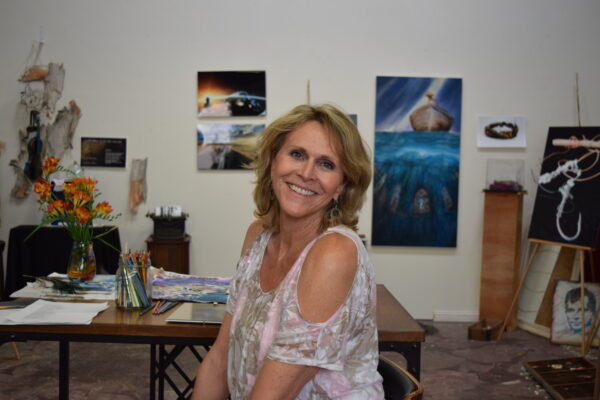
Maybe it’s not the best trait for a journalist, but when it comes to those who make art, few things are more appealing than a playful imagination. This is one of the qualities I admire about Cie Gumucio, a Redondo Beach artist with a childlike sense of wonder and also the courage to traverse mediums and to combine her ideas into compelling, eye-grabbing works of art.
In addition, hers is a literary sensibility, which brings us to “Writers in Search of the Sacred,” a multimedia, almost carnivalesque, art exhibit that takes as its impetus four authors and, in the case of her three novelists, three specific works.  There’s Jack Kerouac and “On the Road,” John Steinbeck and “Cannery Row,” Ernest Hemingway and “The Old Man and the Sea,” plus Emily Dickinson and her collected poems. The exhibition opens this evening at Michael Stearns Gallery in San Pedro.
With these particular authors, Gumucio says, “I made a surprising discovery; all their writing revealed a common thread, a yearning for the transcendent and the sacred. Then,” she adds, “I got messy (and made) a bunch of art exploring this idea: painting, pastels, assemblage, sculpture, digital photography and video projection.”
Her creative laboratory, as such, is located in the rear of the former Gallery 608 North in Redondo Beach.
“Many artists,” Gumucio says, “are comfortable with one medium, but I really love exploring as many as possible because in that not-knowing and uncertainty there’s just all these beautiful discoveries.”
In other words, found objects and painted or crafted objects easily go hand in hand.
Regarding that search for the sacred, “Each of these authors did it on their own terms. Emily Dickinson explored it through nature; that was her church in a way of speaking.”

“The soul should always stand ajar,
ready to welcome the ecstatic experience.” – Emily Dickinson, from her “Collected Poems”
For example, we see a birdcage, with one feather just outside the opened door. The cage represents “a self-imposed isolation from the world,” and as for the feather: “It’s not her emerging,” Gumucio says, “but it’s sort of this evanescent aspect of herself that’s come out from the world. She never left the cage herself.”
To complement or further this sense of “space,” and artists of every stripe are always talking about the need for space, of having the room or the time to birth their concepts, there’s a piece entitled “Where Poems Come From,” which can be described as an empty box, the inside of which is painted a deep blue. In a way it’s a kind of metaphysical nest, the representation of stillness and silence that resides within the poem. Beside this work is a transparent bottle filled with small slips of paper, each one containing a word that appeared in one or another of Emily Dickinson’s poems.

“And then there’s Kerouac,” Gumucio says. “I originally thought it would be ‘Jack and Emily, In Search of the Sacred,” because they’re so different. He was going to jazz joints and having sex with everybody, and they were drinking… It was just about having visceral experiences of the world.”
Hearing this, my eyes light up. Who can’t imagine the cinematic possibilities of Kerouac and Dickinson (more intriguing than Lee Krasner, right?) barreling their way across 1950s America, and tooting their horn as they pass Henry Miller (don’t forget “The Air-Conditioned Nightmare”!), just as I can imagine some intrepid writer penning a thriller with James Bond and Nancy Drew as an unlikely but most clever duo. But back to Jack and Em.
“It’s really interesting because they were both wild in their own way,” Gumucio says. “It’s just that it took on a different form. And they’re both curious. Curiosity is a huge factor in how they approach their own search for transcendence to the sacred.”

An old manual typewriter holding tight a single sheet of paper, the page imprinted with a tire track, seems to sum up Kerouac’s grand adventure, at least his physical one.
But if that had been all, Gumucio would not have been interested. She knows that Kerouac had a questing mind, an inquisitive nature, “and I think that’s probably why he has survived time. It’s not just a romp across the United States.”
“the only people for me are the mad ones, the ones who are mad to live, mad to talk,
mad to be saved, desirous of everything at the same time, the ones who never yawn or
say a commonplace thing, but burn, burn, burn like fabulous yellow
roman candles exploding like spiders across the stars.” – Jack Kerouac, from “On the Road”
Other work on view inspired by “On the Road” includes a video projection to give the impression that we’re behind the wheel with Kerouac (and Em?), looking through the windshield. A portrait of the writer is painted on old road maps, except that there’s virtually no evidence for the viewer that this is true. We’ll have to take Gumucio’s word for it, which is kind of like someone showing you a coffin and saying there’s a corpse inside–you need to have faith and to use your imagination at the same time. A third piece illustrates a two-lane highway with cigarettes for the dividing lines, and with coffee cups like milestones along the shoulder. Cigarettes? Black coffee? It’s writer’s fuel, baby, fuel!

Gumucio’s attraction to Hemingway’s “The Old Man and the Sea” focuses on a large painting of a fisherman in his tiny boat, having ventured out farther than he’s ever done. We see religious imagery under the surface of the sea, indicating that the old man isn’t so much fishing for compliments like the rest of us, but rather for meaning and significance and perhaps a comforting sense of faith.
There is also a bamboo fishing rod with a rosary attached to the end of the hook, another instance of Gumucio melding various mediums, but how all this came together is something of a magical tale in itself:
“I knew that I wanted to have a fishing pole (in the piece),” she says. “I had the rosary–this is actually from my first communion–and I attached the hook and I was like, okay, that works. But I didn’t have a fishing pole, and obviously I didn’t want to use a modern fishing pole because it’s a poor fisherman.
“I was walking (by the tideline), near the Charthouse,” she continues, and while doing so she was berating herself for possibly going in over her head on this project. “And I’m walking, and my eyes are closed and my feet were in the sand, I was barefoot, and as I was saying ‘God, am I crazy for doing this?’ this piece of bamboo just rolled up in the water and deposited itself at my feet. I swear to you, I couldn’t believe it. I was like, okay, I’m just gonna keep doing this!”
We laugh at the “coincidence.” The only thing more obvious would have been a handwritten message suddenly appearing in the clouds above the horizon.

John Steinbeck is someone Gumucio appreciates for his “gracious view of humanity with all its frailties. He was an environmental writer, passionately interested in jazz, politics, philosophy, history and myth.” To encapsulate in tangible form the elements of “Cannery Row” she has assembled an open-face box with numerous small compartments, each of them filled with shells, hooks, netting, feathers, pebbles, and the sorts of things one might associate with a Northern California cannery and the working class people who rose and fell with its fortunes. The novel is a homage to those who lived in Monterey during the Depression of the 1930s.
Cie Gumucio’s work with its intriguing juxtapositions invites our curiosity just as the curiosity of Emily Dickinson, Jack Kerouac, Ernest Hemingway, and John Steinbeck invited hers.
“I hope to create art that provokes a conversation about the meaning and mystery of being human,” she says, and from what I have seen she’s doing precisely that.
“Writers in Search of the Sacred,” a multimedia art exhibition by Cie Gumucio, opens with a reception tonight, May 7, from 6 to 9 p.m., in Studio 347/Michael Stearns Gallery, 347 W. Seventh St., San Pedro. An additional reception, also from 6 to 9 p.m., takes place on Thursday, June 4. More information at michaelstearnsstudio.com.